Mastic resin
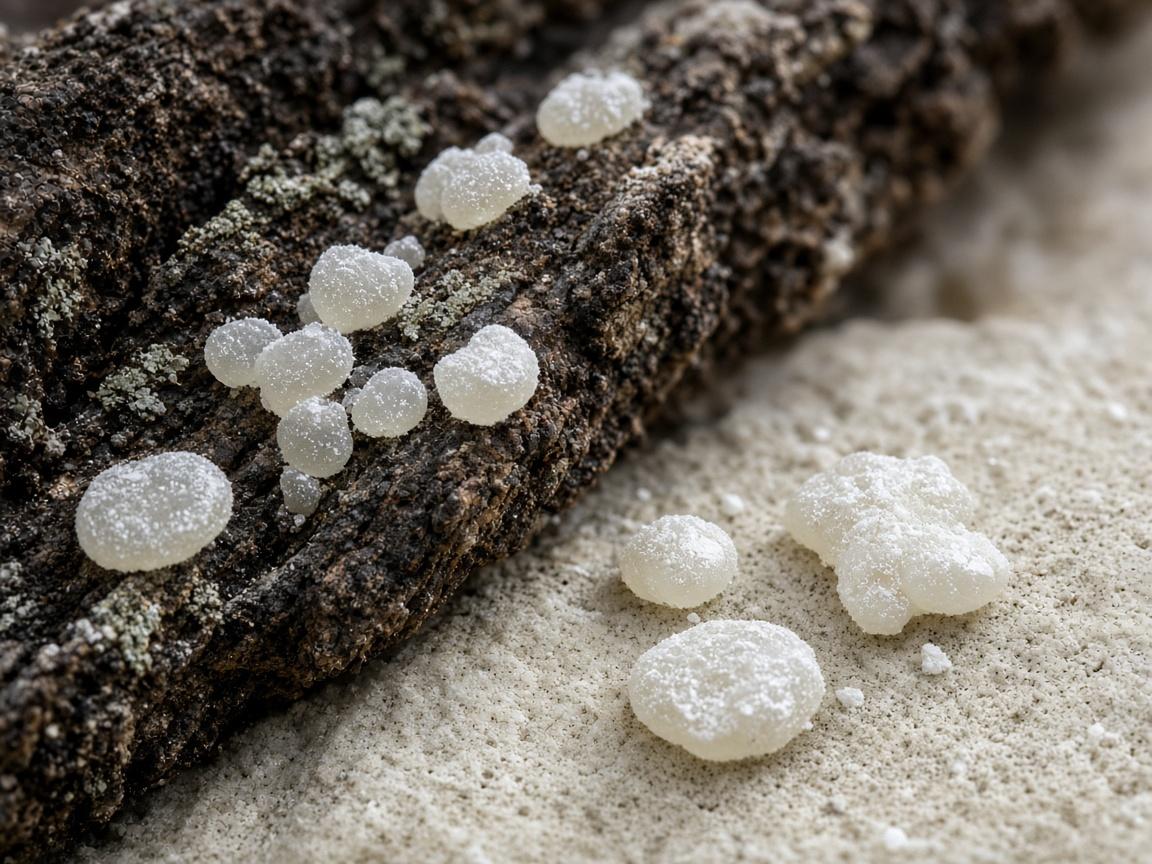
Mastic is the resin of Pistacia lentiscus, the mastic tree associated with the south of Chios, in Greece. The name Masticha Chiou is a protected designation of origin for that resin. It was first registered in the European Union on 24 January 1997, in the class of natural gums and resins. People in the eastern Mediterranean have chewed it for centuries. The tears are milky white when they dry.
Published research has studied mastic itself, not PHÓS. A preliminary study of mastic chewing gum, in 25 periodontally healthy volunteers, reported fewer mutans streptococci in saliva after chewing than after a placebo gum. The authors called the work preliminary. It does not show that PHÓS prevents caries, and this page does not say that it does.
The European Medicines Agency has a herbal monograph on mastic, Pistacia lentiscus L., resin. The assessment is final. One recorded traditional use is for mild dyspeptic disorders, and the monograph says that traditional use rests on long-standing use. That is a regulatory description of the resin. It is not a claim that PHÓS treats digestion, and it is not a dose for this gum.
Plain mastic gum
Chewing the resin on its own is as natural as the tree. It is also a difficult chew. The tears set firm. The aroma is the resin itself, and the taste is bitter at first. Most people do not stay with it. That is the drawback of the plain material, not a fault in the tree.
Conventional gum
Most chewing gum sold today is built for an easy chew and a familiar flavor. The base is often not a tree resin. United States food rules, in 21 CFR 172.615, allow a list of masticatory substances in chewing gum base, in amounts needed for the physical effect. The synthetic list includes polyvinyl acetate and polyisobutylene, polymers in the same broad family as plastics. The rule is a permission, not a finding that every brand uses them. No brand is named here.
A UCLA pilot study, presented at the spring meeting of the American Chemical Society in San Diego and described by UCLA Newsroom on 22 April 2025, measured microplastics in saliva after gum was chewed. Sanjay Mohanty and Lisa Lowe tested ten commercial gums, five described as synthetic and five as natural. On average they counted about 100 microplastic particles per gram of gum. Some pieces released up to 600 per gram. A typical piece weighs about 2 to 6 grams. Natural and synthetic gums released similar amounts, which the researchers said they had not expected. About 94 percent of the particles came off in the first eight minutes.
Mohanty, the principal investigator, said the goal was not to alarm anybody. Scientists do not know whether microplastics are unsafe for people. There are no human trials. The study is about exposure from chewing gum in general. It is not a test of PHÓS, and it does not show that a mastic gum sheds none.
Focus, caffeine, and L-theanine
Naturally caffeinated from matcha leaves — 40 mg of caffeine per piece, balanced with L-theanine.
Contains caffeine. Not recommended for children, pregnant or nursing women, or those sensitive to caffeine.
That 40 mg is the amount in one piece of PHÓS Focus, and it comes from matcha leaves. Focus also contains L-theanine. No amount of L-theanine is stated, because none is published here. PHÓS Refresh contains no caffeine.
Research has studied L-theanine together with caffeine. The studies used drinks or capsules, not this gum, and the amounts are not the formula of Focus. A placebo-controlled study of 44 young adults gave 97 mg of L-theanine with 40 mg of caffeine. Compared with placebo, the combination was reported to improve accuracy on a task-switching test and to raise self-reported alertness. A separate randomised crossover study gave 250 mg of L-theanine with 150 mg of caffeine. The authors reported that the combination differed from caffeine alone, including faster simple reaction time and higher alertness ratings in that trial. Those are findings about the doses in those studies. They are not effects claimed for PHÓS.
The best of both worlds.
Plain mastic brings the resin and a difficult chew. Conventional gum brings an easy flavor and, often, a synthetic base. PHÓS is being made to sit between them. The marks below are a reading of that idea. They are not a laboratory certificate.